


17 Apr Counting in the Early Years
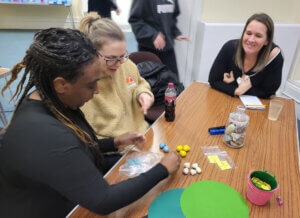
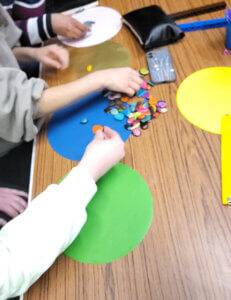
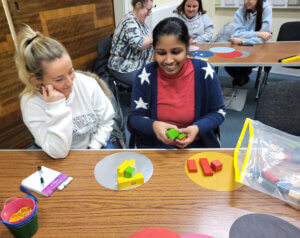
Earlier this year our teams attended a bespoke training session, Counting in the Early Years. This was an interactive session around supporting Mathematical development in our Community of Nurseries and organised in groups, specific to the age group that our practitioners work with, to ensure future application is relevant to children in our care.
Let’s face it, as adults, maths is one of those subjects that we either like or dislike; feel confident with or shy away from. Such feelings may impact the way we may teach Maths to children, who are very intuitive and can pick up on any negative energy when being taught a new mathematical skill. So, we wanted to ‘shake things up’, start from the very beginning and jump into the world of Mathematical development in the Early Years. We are keen to boost positive feelings around maths and have fun supporting children as they begin their mathematical learning journey!
‘The first few years of a child’s life are especially important for mathematics development. Research shows that early mathematical knowledge predicts later reading ability, general education and social progress. Conversely, children who start behind in mathematics tend to stay behind throughout their whole educational journey’ (quote ncetm).
 Jancett Childcare understands that Maths in the Early Years sets the tone for lifelong learning and so we aim to provide children in our care with FUN and INTERESTING Maths’ activities, to guide and shape their view of learning for the future. Where early mathematical development is crucial, we were keen that our teams had the very best awareness of how to teach early mathematical skills.
Our teams discussed how we incorporate Maths into our curriculum and everyday routines, sharing existing practice which includes:
- Counting, building, balancing and shapes
- Problem solving – Learning to crawl, walk, and spatial awareness
- Rhymes, puzzles, number blocks and stories.
- More, less, big, small, full, empty, heavy, light – Mathematical Language encouragement all the time.
Maths in the Early Years is a big subject and so we focused the session on counting, where we explored the following key areas – Cardinal, Ordinal, Subitise and Conservation. Below you will find the definitions along with some examples and useful hints and tips.
 Cardinal numbers ‘are numbers that are used for counting real objects or counting things (things you can pick up or see). They are also known as “counting numbers” or “cardinals.” We commonly use cardinal numbers to answer the question starting with “How many?’ Definition source splashlearn
- Our youngest children will focus on 1, 2 and 3 objects setting the foundations for a deep understanding of numbers up to ten, by end of EYFS curriculum/Reception.
- With Cardinal numbers the actual number labels (1,2,3..) do not mean much. We focus more on counting real objects such as rubber ducks, cars, trees and using things that the children show interest in – to make maths engaging.
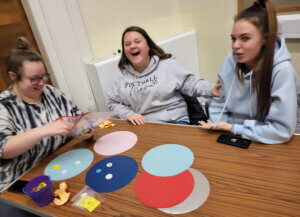 We use ordinal numbers when we count in order 1,2,3,4, onwards. Ordinal number words are- 1st – first, 2nd – second, 3rd – third and so on… Definition source bbc
- You can see ordinal numbers in a number line and children will gradually be able to picture where they belong, for example where the number 3 is positioned in a line.
- Counting and learning the number names in order supports this development.
Later in Nursery Life children will learn to match Cardinal and Ordinal numbers. They will learn that the Number three, in a line of 1, 2 and 3, is the same as seeing 3 rubber ducks/cars, trees….
‘Subitising is being able to visually see a number of objects instantly without needing to count them out one at a time.’
- Subitising is crucial skill that many of us use on a daily basis without even realising it. source bbc
- Children under 5 are able to do this with three or less objects.
- At Nursery we encourage this through cause-and-effect games, sorting and comparing (tidying up, what goes in which box), block play (build them up 1,2,3,4 and blow them down..YAY!!) and grouping games.
‘Conservation is a term constructed by Jean Piaget, which describes a child’s understanding that the quantity of an object is unchanged, even if it is rearranged’, cut poured or even stretched (Gough, 2008; NSW DET, 2003)
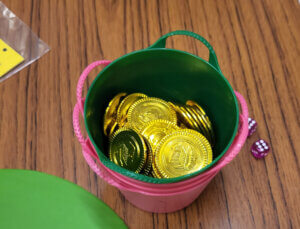
- Children aged 4 and 5 will show understanding here. However, if we support this earlier than age 4 their understanding will become easier and be deeper.
- Activities that support this is to have 2 rows of blocks placed the same and then spread out one row. Another fun way is through play with water or playdough, by pouring and stretching.
Our teams had a great session about counting in the Early years, where we took part in activities ourselves and shared ideas for maths’ displays to encourage visual learning. If both Educators and Parents introduce maths early we will create a strong baseline for learning and a love of Maths!
 Some ideas to try at home:
- Counting up and down the stairs, steps to the garden or the shops.
- Block play- build it up and knock it down- children love to do this over and over again. You could also introduce mathematical language such as number names, big, tall, short, long, up and down.
Counting rhymes are a wonderfully fun way to learn early Maths. Our team members will be more than happy to share the tune and words – I bet they will even sing it for you and your child:
- 1,2,3,4,5 once I caught a fish alive
- 10 in the bed and the little one said
- The ant song, the ants go marching
- 5 speckled frogs
- 5 men in a flying saucer
- 5 little ducks
- 5 little monkeys
- 1 potato 2 potato
- 5 current buns
- 1 little finger – tap tap tap
- This old man/lady
Clapping – counting the claps. Notice the pattern for our 4-to 5 year olds.
Subitising – look at 3 coins, know it is 3 without needing to count; or arranging 2 groups and children learn there are more in one group than the other (patterns are easier to subitise 6 dots/4 dots of a dice)
Stories that teach maths that are already part of our curriculum:
- Dear Zoo
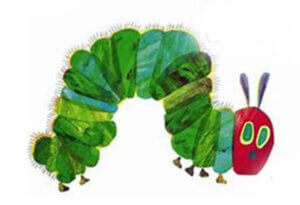
- The Very Hungry Caterpillar
- Jack and the beanstalk
- Goldilocks and the three bears
- The Enormous Turnip
- The three little pigs
- 10 tiny babies
That’s all from me today. Thank you for taking the time to read our blog. We hope that you found it interesting and useful; we have certainly enjoyed introducing more Maths into our Nurseries!
All the best
Lisa