

17 May Role models of all ages
As we mark our 50th anniversary this year (1969-2019), we think about all the nursery children and families we’ve had the pleasure to work with over the years, and a question naturally came up in conversation which we thought would be apt to explore in this month’s blog – when it comes to role models, what can the very young learn from spending time with the older generation?
The term ‘Inter-Generational Relationships’ might make us first think about a traditional bond between an older relative and child, but ‘Inter-generational care’ is now a professional practice too and, in 2018, Nightingale House in Wandsworth opened as “the first of its kind in the UK that integrates both older residents and children into the delivery of the curriculum and elderly care.”
In 2019, United for All Ages published a report – The next generation: how inter-generational interaction improves life chances of children and young people – which explores the value of the young and old spending time together. For several years now Startel Day Nursery has worked in partnership with Friends of the Elderly and ‘Triangle Day Care’ in Wallington, so that the very young children can spend time with the senior residents, having a sing-a-long for Harvest Festival or taking part in a festive pantomime performance in December.
Whether it’s spending time with a grandparent, neighbour, care home, or via a ‘twinning’ service like Nightingale House, inter-generational relationships can equip children with valuable life skills and experience, including….
..how to lend a helping hand
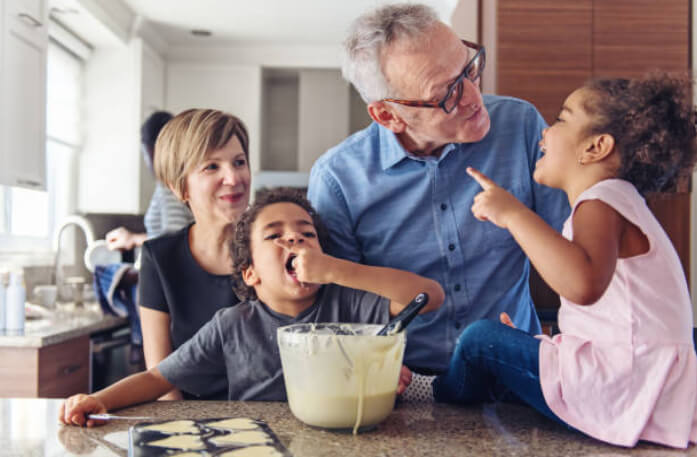
We can probably all recall spending time with our grandparents or older relatives / friends when we were young, perhaps gardening, cooking, or ‘assisting’ in some household chore or other. Not only was it a clever babysitting technique to keep a child engrossed for hours, a ‘helping’ activity can also teach children about generosity and giving to others.
If the elderly person has a medical condition or isn’t as mobile than they once were – they may use a wheelchair or stair lift – a child can see first hand how that older person copes, what they do differently to them, and what they need. This can all teach a young child about caring, patience, empathy, and compassion.
Children’s language, listening and comprehension skills can also be greatly developed through time spent with somebody much older. If a grandparent or neighbour has poor eyesight or hearing, a child may have to speak more slowly or clearly, describe things more, or learn sign language to communicate with them.
..not to fear the ageing process
Spending time with someone a good deal older can help children see beyond certain ageist stereotypes they might otherwise encounter (for instance from a book or on a TV show). A staff member told this blog she’d overheard a child telling an elderly woman her silvery-grey hair reminded him of his pet goldfish! Such a funny observation, but it goes to show how he’d noticed her hair colour, was curious about it, and in telling her exactly what he thought, she was then able to explain the signs of ageing.
Although loss is something we hope to guard young children from, if an elderly person a child is close to passes away, they may experience bereavement for the first time, and guiding a child through their grieving process might inevitably have to happen.
It is therefore cheering to note research suggests inter-generational relationships may actually help us all to live longer. This Telegraph article explains how inter-generational relationships can extend lives. Children can provide fun, energy and companionship to an older person who may otherwise feel isolated or alone.
..so many social skills
The older generation naturally have more life experience, advice to give, and tales to tell, and we all know how much children love a good story time!
Children can learn about their own family history, about historic world events, and how life used to be from listening to an older person’s stories. The fact that a child is listening, is another skill they’ll learn during time spent together. A child might ask questions, and in doing so, can develop their observation, imaginative and critical thinking skills too during story time.
Attending a family event, or visiting a local care home can also give children confidence and increase their social skills, helping them at a young age to feel comfortable mixing with and talking to people of all different age groups.
Our Marketing Officer recalls how much she loved spending time at her grandmother’s house when she was the same age as our nursery children: “Granny had a steady stream of friends who’d pop in each day and I was always included in their tea and biscuits. Looking back, her friends would probably have preferred a proper ‘grown up’ chat and for me to go and play in the other room, but they always made me feel part of their conversations. I genuinely loved just being in their company.”
..comfort and cuddles
JACE Training‘s Tutor and Assessor, Paula mentioned how spending a day each week with her 2-year-old granddaughter has enabled her to gently prepare her granddaughter for the arrival of a baby sibling this summer. A grandparent or older family friend can offer a different perspective from a parent, carer or nursery staff. As Paula explains “Being a grandparent, you don’t feel the same pressure you felt as a parent. You can enjoy making a fuss and spoiling them, but you can also be another role model for them and help out if needed.”
While there may be decades in age and experience between the very young and the very old, we’d like to end this blog with a quote from this article which describes the biggest similarity they share :“In those at either end of the life course – the young and the old – you find striking similarities. We live in a society that values adulthood, and in turn doing – productivity and ongoing activity. The young and the old share a different rhythm. It’s one that focuses not only on doing, but on the power of being. It’s the simplicity of playing with blocks or tending to flowers. The young and the old are most closely connected with the essence of living. Rather than time being the enemy – rushing time or stressing to fit as much into time as possible – time becomes a comfortable companion, a circle rather than a line.”
Keep up to date with our 50th anniversary activities and events over on our Twitter page, and follow our hashtag #JancettAt50.
Main Image credit: Google