


21 Sep Why is block play so important?
“Play is the highest level of child development. It is the spontaneous expression of thought and feeling – an expression which (their) inner life requires.”
(Froebel in Lilley 1967:83)
Our team of educators have very recently taken part in a fascinating ‘block play’ workshop, led by our educational consultant Katharine Davies. The session was enjoyable, creative, and insightful.
Children have played with blocks for centuries but it was the German educator Freidrich Froebel who noticed the learning benefits children can experience when playing with blocks. Froebel’s story is interesting and many theorists have since added to the research into block play, you can read more about Froebel and the history of block play HERE.
I would like to jump right in and share with you the importance of block play and the wealth of possible learning outcomes that can be developed. Most of all I would like to highlight how we can all make the most of this wonderful resource, that is so adaptable for many different ages and stages of child development. I hope you enjoy the read, if you have any further questions or feedback, please drop me an email at [email protected].
The seven stages of block play. Who knew that the simple and enjoyable activity of playing with blocks had seven stages!
Stage one – Exploration
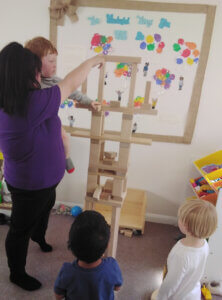 Our youngest children start their block play journey using their senses. Babies will feel the weight, and texture of the blocks. They will hear the sound they make when the tower falls or when two blocks clash together. Young children will see different sized blocks and enjoy reaching for them, picking them up and moving them to another area. Young children will start to pass the blocks to each other and begin to explore the process of block play.
Stage two – Building rows and towers
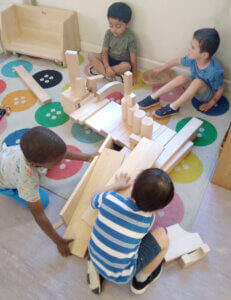 Once children know and understand the ‘feel’ of the blocks at around age two children will start to use their blocks to build in straight lines or curves in rows along the floor or table. Children will start to build towers up high and explore hight, stacking and falling. The art of balance and coordination come into effect at this stage and will underpin all future block building projects. Children will often start to represent their towers as a tall tree or a long windy river.
Stage three – Bridging
 Children will use trial and error to build two or more towers and try to place a block across the top of the towers to form a bridge. When building a bridge with two towers becomes a skill you will notice that the bridges might start to become more complex. This is the perfect time to introduce different structures using columns, arches, and some decorative details.
Stage four – Building Enclosures
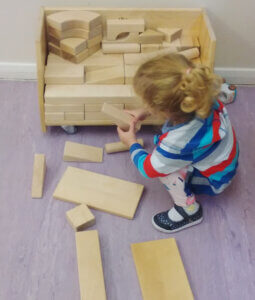 Problem solving and planning begin here, the children start to build with a motivated objective. Children start to use their previous learning of bridges, balance, and towers to explore inside, outside and perimeter. This is a great stage to introduce small world objects such as farm animals and people. Children will enjoy creating a farmyard with specific places for the cows, chickens and the farmer and tractor.
Stage five – Elaborate Structure
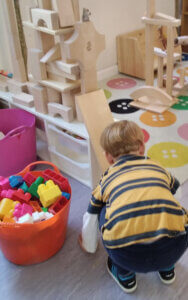 You will notice that the children’s towers start to be symmetrical with a planned pattern and enhancing features such as flowerbeds and trees. The children may classify their building as a house, flat, zoo or even a castle. To facilitate this interest adults can talk to children about the different buildings and structures you see while you are reading stories or out for a walk, this will spark further ideas, plans and inspirations for children to use during their block play.
Stage six – Planning and Building
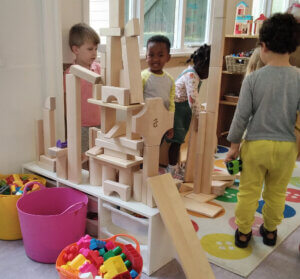 The final stage of block play normally starts around age five, this does depend on how often children have the opportunity to build with blocks and the adult guidance they have had. At this stage you will notice children working alone or with others start planning and making decisions before the building takes place. The children will start to build more complex designs such as a whole town, fortress, or detailed castle. You may notice that children immerse themselves into the world of imagination incorporating roleplay costumes and storylines.
Learning and development outcomes
Block play provides active engagement and meaningful open-ended play, meaning the possibilities for development and learning is endless. Block play encourages verbal and non-verbal communication, sharing, turn taking and collaborative skills when working in a group. Children’s imaginations can come to life when building their own creations, there is no wrong or right way to play with blocks. It promotes free thinking play that leads to creativity, ideas, and independent learning. Science, Technology, Engineering and Mathematic (STEM) development is stimulated through block play, for example, cause and effect and trial and error – thinking such as ‘if I do this, this happens’ and ‘oops the tower fell down, let’s try a different way’. This supports children to have a ‘can do’ approach to learning and ignites those early problem-solving skills. Mathematical concepts such as weight, balance, symmetry, and pattern may be explored through block play.
I could continue to discuss the positive benefits, learning and skills that block play can promote. If you would like to read more, please see below some further articles and reading.
I would like to thank Katharine for the wonderful knowledge she has shared with the whole Jancett Childcare team – we all had a great time learning about block play, and my personal favourite was playing with blocks while working with my team, creating an enormous castle using communication, teamwork, collaboration, laughter, and fun!
We would love to see some of your creations while playing with your child and a set of building blocks, feel free to share them with us on our social media pages and hashtag #blockplaywithjancett.
Thank you for taking the time to read this blog. Keep an eye on our social media pages for the wonderful Jancett community block play exploration and structure building coming soon!
Information gathered from and further reading below
Community Playthings | Froebel’s gifts and block play today
Frobel’s gifts and block play today
7 stages of block play: Building and early learning – Spokane County Library District (scld.org)